A Dense Fog Advisory means the fog is thick enough to make driving dangerous. The National Weather Service issues one when widespread dense fog develops, and under it, visibility frequently drops to a quarter of a mile or less. For St. Lucie County the advisory comes from the Weather Service office in Melbourne, which forecasts for our county.
This page covers what the advisory means, what a quarter mile of visibility looks like at highway speed, how the Weather Service says to drive in fog, and when to pull over. Everything here comes from the National Weather Service; the sources are listed at the end.
What a Dense Fog Advisory means
“A Dense Fog Advisory is issued by your local National Weather Service office when widespread dense fog develops. When this happens, visibilities frequently drop to one-quarter of a mile or less. These conditions make travel difficult.”
The Weather Service’s advice under the advisory is short: take extra caution on the road, or avoid driving if you can. For how advisories sit beside watches and warnings, see our guide to weather alert types.
A separate alert, the Freezing Fog Advisory, is issued when fog forms and surface temperatures are at or below freezing. The tiny droplets in the fog can then freeze on contact with cars and roads. The Dense Fog Advisory is defined by how far you can see.
What a quarter mile looks like at highway speed
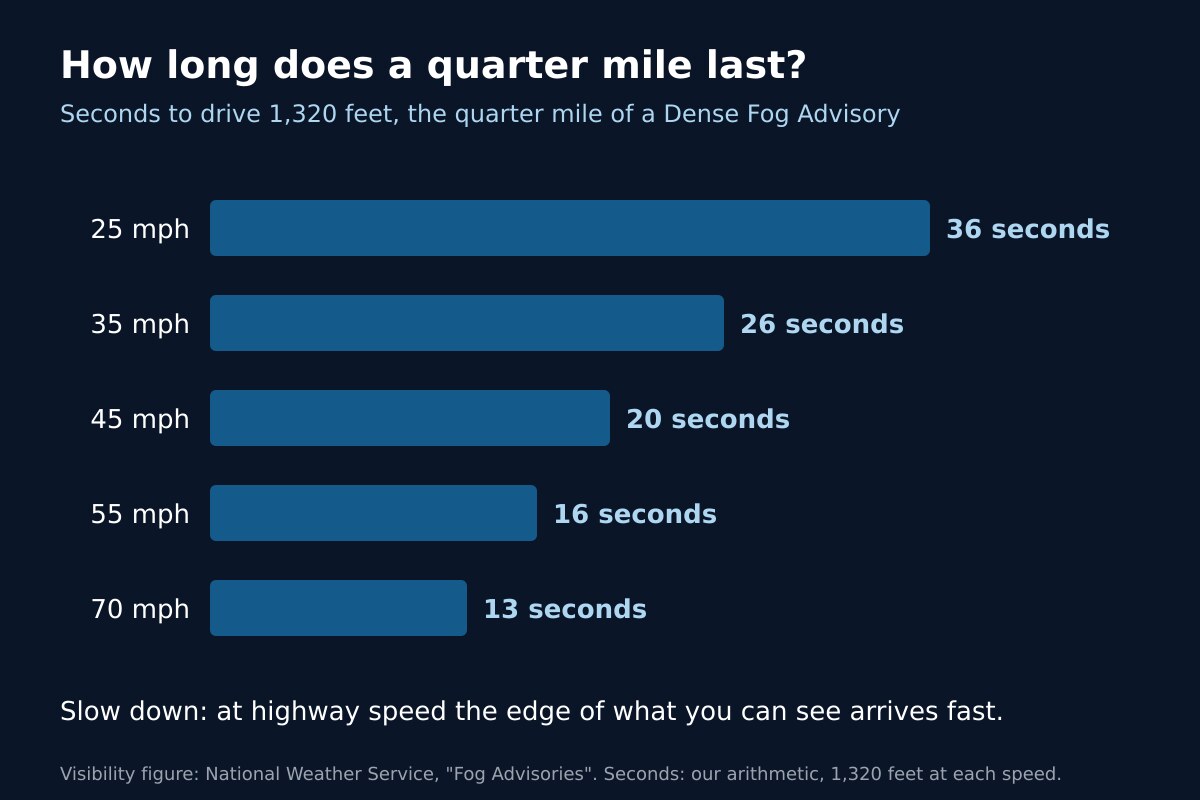
A quarter mile is 1,320 feet. That sounds like a lot of room until you work out how fast a car covers it. At 70 miles an hour a car travels about 103 feet every second, so it reaches the edge of a quarter mile of visibility in about 13 seconds. At 45 miles an hour it takes about 20 seconds, and at 25 about 36.
The arithmetic is ours; the quarter mile is the Weather Service’s figure, and in an advisory the visibility can be lower still. That is why the first piece of its advice for fog is to slow down.
How to drive in fog
Fog contributes to many travel accidents every year, the Weather Service says. Both Interstate 95 and Florida’s Turnpike cross St. Lucie County, along with the roads most of us take to work. If you must drive in fog, the Weather Service advises:
- Slow down. Allow extra time to reach where you are going.
- Use your low beams. Low-beam headlights also turn on your taillights, so drivers ahead and behind can see you. Use fog lights if you have them.
- Never use high beams. They cause glare and make it harder to see what is ahead of you.
- Leave plenty of room. Keep a long gap to the car in front, for sudden stops and changes in traffic.
- Follow the lines. Watch the lines on the road to stay in your lane.
When to pull over
In extremely dense fog, where visibility is near zero, the Weather Service says the best course is to turn on your hazard lights first, then pull into a safe place, such as the parking lot of a local business, and stop.
If there is no parking lot or driveway, pull as far off the side of the road as you can. Once you have stopped, turn off every light except your hazard flashers, set the emergency brake and take your foot off the brake pedal. The Weather Service’s reason: with your tail lights dark, other drivers will not mistakenly run into you.
On the water and in the air
Dense fog is a hazard for boaters and pilots as well as drivers, the Weather Service notes. Poor visibility can change takeoff and landing procedures and cause weather delays at airports. If you have a morning on the water planned, check our marine weather page before you leave the dock.
Frequently asked questions about dense fog
Sources
- National Weather Service, Fog Advisories.
- National Weather Service, Driving in Fog.
- National Weather Service, Fog Safety Overview.
Before you head out
See whether a Dense Fog Advisory is up on our St. Lucie County alerts page, or open the command center for everything at once. For storms rather than fog, the live radar is the place to look.