A Freeze Warning means the temperature is forecast to drop below 32°F and stay there long enough to kill some plants. A Frost Advisory is the step below it: areas of frost are expected or already forming, a threat to sensitive vegetation. For St. Lucie County both come from the National Weather Service office in Melbourne, which forecasts for our county.
This page covers what each cold-night alert means, the two temperatures that matter for plants and crops, and the Weather Service’s advice for pets, water pipes and people. Everything here comes from the National Weather Service; the sources are listed at the end.
Freeze warning, freeze watch, frost advisory: three levels
The Weather Service uses the same ladder for cold nights that it uses for storms: a warning means take action, a watch means be prepared, and an advisory means be aware. For how that ladder works across every alert, see our guide to weather alert types.
“A Freeze Warning is issued when temperatures are forecasted to go below 32°F for a long period of time. This temperature threshold kills some types of commercial crops and residential plants, while temperatures below 28°F for an extended period of time can kill most types of commercial crops and residential plants.”
- Freeze Warning: take action. Temperatures are forecast below 32°F for a long period. Protect what you can tonight.
- Freeze Watch: be prepared. Significant, widespread freezing temperatures are possible within the next 24 to 36 hours. That is your lead time to plan.
- Frost Advisory: be aware. Areas of frost are expected or occurring, a threat to sensitive vegetation.
The Weather Service issues the Freeze Watch in the autumn until the end of the growing season, and in the spring at the start of it. All three alerts are about plants and crops first. Dangerous cold for people has its own alerts, covered further down.
The two numbers that matter in the yard
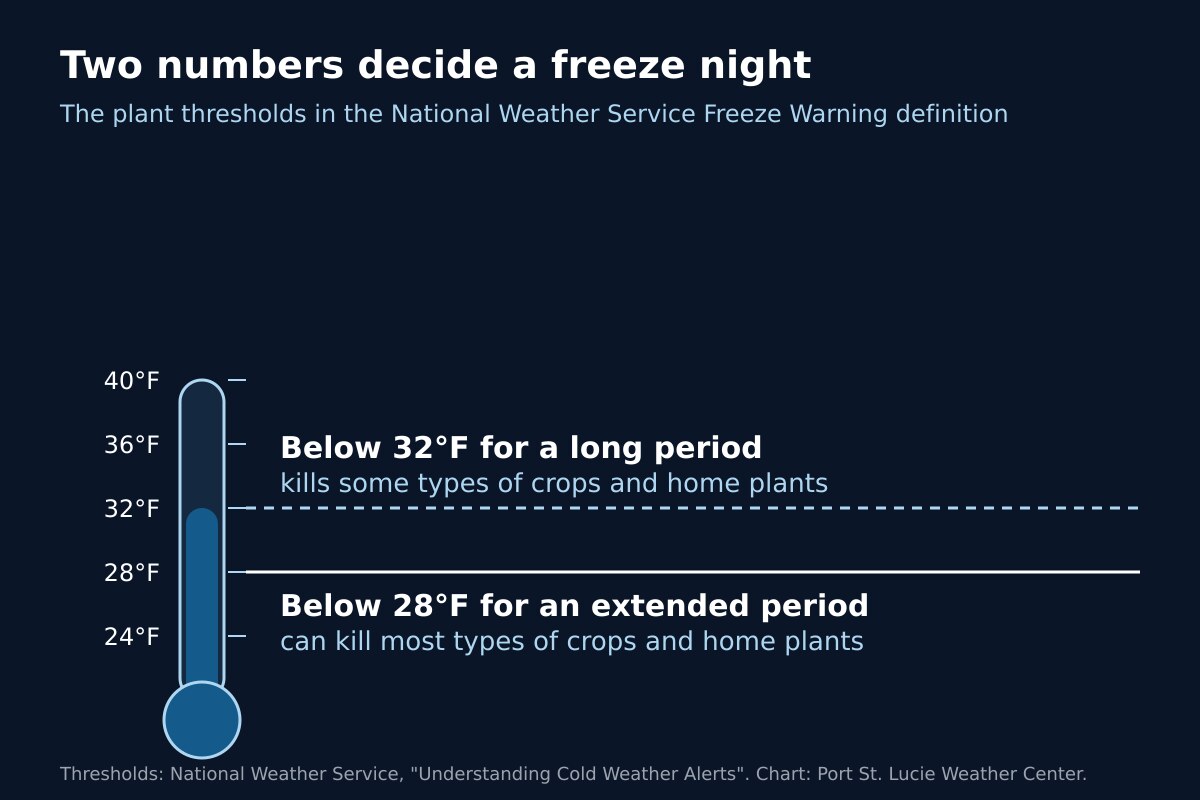
The Weather Service’s definition carries two temperatures. Below 32°F for a long period kills some types of crops and home plants. Below 28°F for an extended period can kill most of them. Time matters as much as the number: both thresholds are about how long the cold lasts, not a single reading at dawn.
The Weather Service’s own advice here is short: know the temperature thresholds of your plants and crops. Work out which of yours are tender before the night a warning goes up, not after.
Before a cold night: pets, pipes and the morning
The Weather Service’s preparation list, the parts that apply at home:
- Check the forecast. Make it part of your routine so a cold night is not a surprise.
- Look after pets and animals. Make sure pets and farm animals are not overly exposed to the cold and have plenty of food, and water that has not frozen.
- Protect your water pipes. Take precautions so they do not freeze.
- Plan around the early morning. The coldest part of the day is typically the early morning. If you can, avoid being outside then, and find a warm spot for children waiting for the school bus.
- Dress for outdoors, even if you do not think you will be out long.
Keeping the house warm
If the house runs cold, the Weather Service suggests wearing layers of loose-fitting, warm clothing, closing blinds or curtains to keep heat in, closing off rooms you are not using, and putting towels or rags in the cracks under doors.
If the power is out and you run a portable generator, use it outdoors only, at least 20 feet from doors, windows and garages. The Weather Service’s reason is carbon monoxide poisoning. It is the same rule that applies after a hurricane, and our hurricane preparedness guide covers power outages in more detail.
Cold is a risk to people too, even here
Hypothermia is when the body’s temperature sinks below 95°F, and it needs medical attention right away. The Weather Service notes that it can happen in temperatures as warm as 60°F, particularly in water, or when someone is outside a long time without dressing for the weather. Anyone fishing or boating on a cold morning should keep that in mind; check our marine weather page before you leave the dock.
Older people are at particular risk. As we age, the Weather Service explains, the body gets less efficient at telling us we are cold, and older people tend not to shiver as well, which is one of the ways the body warms itself. Its advice:
- If you live alone, ask a family member or neighbor to check on you every day.
- Ask your doctor whether any medicine you take raises your risk of hypothermia.
- Eat hot food and drink warm drinks several times a day.
- Once your own household is safe, check on neighbors who might be vulnerable.
If your temperature is 95°F or less, you feel cold and sluggish, or you are having trouble thinking clearly, the Weather Service says to see a doctor immediately or go to the nearest emergency room. If you are helping someone who may have hypothermia, call an ambulance first.
When the cold is dangerous to people
The freeze and frost alerts are about plants. When cold or wind chill is a danger to people, the Weather Service uses a separate set: the Cold Weather Advisory for dangerously cold conditions below warning level, the Extreme Cold Watch when extremely dangerous cold is possible but uncertain, and the Extreme Cold Warning when it is expected or happening. Under an Extreme Cold Warning, the advice is to avoid going outside.
Frequently asked questions about freeze and frost alerts
Sources
- National Weather Service, Understanding Cold Weather Alerts.
- National Weather Service, Prepare for Cold Weather.
- National Weather Service, During Extremely Cold Weather.
Before a cold night
See whether a Freeze Warning or Frost Advisory is up on our St. Lucie County alerts page, or open the command center for everything at once. For storms rather than cold, the live radar is the place to look.