The National Weather Service office in Melbourne, which issues the weather alerts for St. Lucie County, heads its rip current page with a sentence worth reading twice: in east central Florida, rip currents are more deadly than tornadoes, hurricanes and lightning combined. That includes every beach in St. Lucie County.
The trouble is that rip currents rarely look dangerous. The National Weather Service notes they often form on calm, sunny days, the kind of day that brings everyone to the beach. This page covers how to spot one, what to do if you are caught, and what the alert means when it shows up in our feed.
What a rip current is
A strong, narrow, seaward flow of water that runs from close to the shoreline out through the surf zone and beyond. Rip currents are driven by breaking waves and can form on almost any beach that has surf.
Breaking waves push water up onto the beach. That water has to get back out to sea, and it does not go evenly. According to the NWS rip current science page, rips tend to form where waves break less, in a stretch sandwiched between areas where they break more. Water runs along the beach in feeder currents, meets where the waves break less, and turns seaward in a narrow, fast lane.
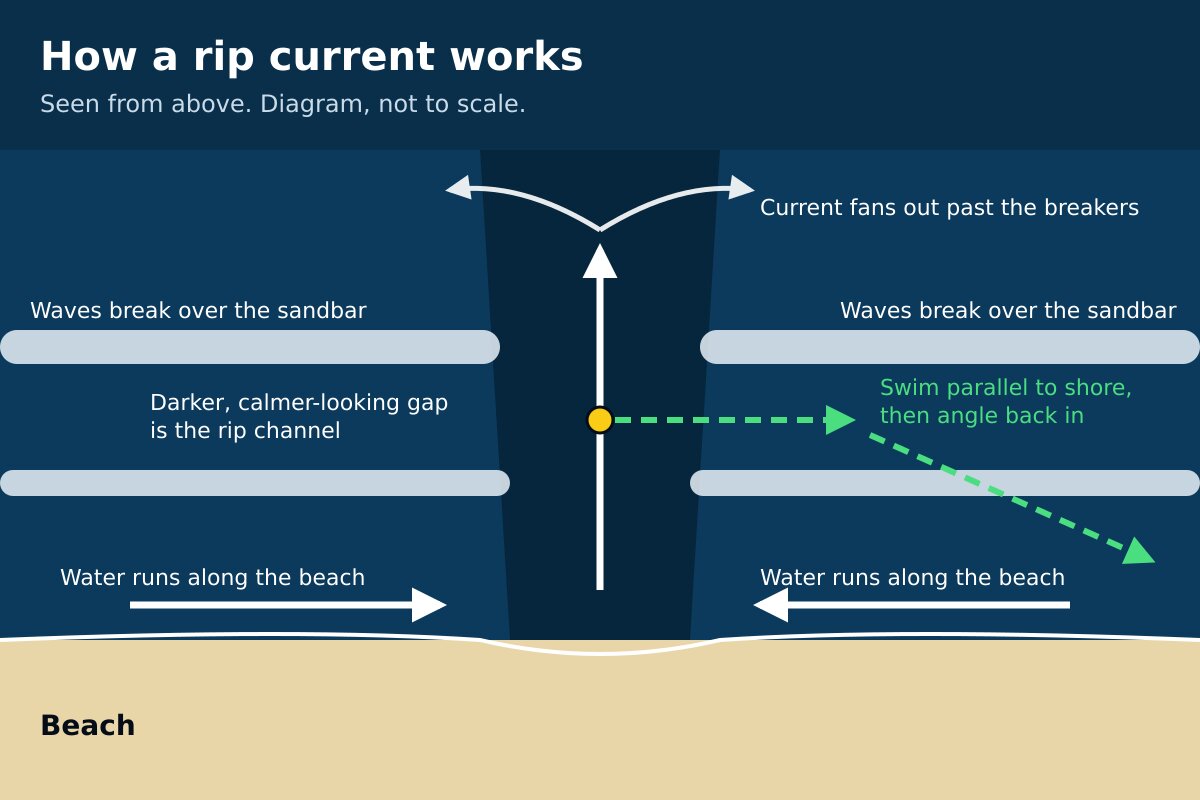
The most common kind runs through a channel cut between sandbars. These channelized rips can stay in one place for days, weeks or months. The NWS puts their usual width at 5 to 100 yards, and their spacing along a beach at anywhere from 50 to 500 yards. NWS Melbourne keeps a photograph of exactly this on its page: a rip channel cut through a sandbar at Vero Beach after Hurricane Jeanne.
Rips also form next to fixed structures such as jetties, groins and piers. The NWS says these structural rips stay put and can run even when the waves are small. Anyone swimming near the inlet jetties should keep that in mind.
How fast a rip current moves
Channel rips usually flow at 1 to 2 feet per second, and can reach 8 feet per second. NOAA puts the top end in plain terms: faster than an Olympic swimmer. Even a weak rip can make it hard to stand still in waist-deep water.
Two things change the speed from minute to minute:
- Wave sets. When a group of bigger waves breaks, the water level near shore jumps and the rip pulses for 30 seconds to a minute. The NWS says the flow can more than double during a pulse, and that pulses are often what gets people into trouble. Waders lose their footing and get carried out.
- The tide. On beaches with a tide range under six feet, the NWS says rips often run faster an hour or two either side of low tide, when the water is shallow and waves break hardest, and can stop altogether around high tide. Check the tide time before you go, and be most careful near low water.
How to spot a rip current from the beach
The NWS lists these signs. They are easier to see before you get wet than once you are in the water.
- Look from higher ground. A dune crossover, a boardwalk or the top of a beach access gives a much better view than standing at the water's edge.
- Look for a gap in the breaking waves. A channel rip shows up as a narrow strip of darker water between areas of whitewater. It can look like the calmest place to swim. It is not.
- Look for choppy, rippled water heading out. Waves coming in steepen where they meet the outgoing flow, so the surface texture looks different.
- Look for sand or foam moving seaward beyond the line of breaking waves.
- Look for scalloped dips in the shoreline, which a channel rip can carve into the beach.
- Wear polarized sunglasses. They make deep channels stand out as darker water.
- Ask the lifeguard whether there are rips today, and to point them out.
If a rip current carries you out
NOAA's advice is short. Do not fight it. Swimmers who try to swim straight back to shore against the current wear themselves out, and that fatigue is what puts them at risk of drowning. Instead:
- Stay calm. The current carries you away from shore, but it will not pull you under.
- Swim parallel to the shore, out of the narrow lane of current.
- Once you are out of it, swim back to land at an angle.
If you see someone else caught, get a lifeguard. The NWS puts the best protection first: swim at a beach with lifeguards. The NWS cites the United States Lifesaving Association's figure that the chance of drowning at a beach with lifeguards is 1 in 18 million.
Rip current, rip tide, undertow: three different things
People use these words interchangeably. The scientists do not, and the difference matters for what you do.
- Rip current: the wave-driven seaward flow this page is about.
- Rip tide: NOAA uses this for strong tidal current moving through inlets and the mouths of estuaries and harbors. On our coast that describes the Fort Pierce and St. Lucie inlets. It is a hazard too, but a different one.
- Undertow: water returning seaward along the bottom. The NWS says it is usually slower than a rip current and typically not a hazard to swimmers, and that neither undertow nor a rip current will pull a person under.
One more myth worth retiring. When waders suddenly find themselves in deep water, it is often blamed on a collapsing sandbar. The NWS says sandbars do not collapse. They shift over days to months, or over hours in a big storm. The usual culprit is a set of bigger waves raising the water level, often with a rip pulse on top of it.
What a Rip Current Statement means
A Rip Current Statement is the National Weather Service alert for dangerous rip currents. For our coast it comes from the Melbourne office, and it is one of the alerts our St. Lucie County alerts page picks up. When you see one, take it at its word even if the water looks inviting: swim only near a lifeguard, stay out if you are not a strong swimmer, and keep children in arm's reach at the water's edge.
For how this alert sits alongside the others NWS Melbourne issues, see weather alert types explained and how to read an NWS alert. For the wind and wave side of a beach day, see marine weather and our explainer on the sea breeze, which builds the afternoon chop.
Frequently asked questions about rip currents
Sources
- National Weather Service Melbourne, NWS Melbourne Rip Current Program.
- National Weather Service, Rip Current Science.
- National Weather Service, How to Avoid Getting Caught in a Rip Current.
- NOAA National Ocean Service, What is a rip current?
Before you head to the beach
Check whether a Rip Current Statement is up on our live alerts page, look at the wind and storms on the radar, or open the command center for everything at once.