Fishing is the leading activity in lightning deaths in the United States, according to the National Weather Service, and general beach activities such as sunbathing and playing ball come second. On the Treasure Coast, that describes an ordinary afternoon: anglers at the Fort Pierce Inlet, boats on the Indian River Lagoon, families on the sand at Hutchinson Island.
This page covers lightning safety on our coast: how far lightning can reach from a storm, how to judge the distance yourself, why the beach is a hard place to stay safe, where to shelter, and what to do if someone is struck. Everything here comes from the National Weather Service; the sources are listed at the end.
Why the beach and the water are risky in a storm
The Weather Service gives three reasons beach activities account for so many lightning deaths:
- You may not hear it coming. The sound of thunder is hidden by the surf and by people having fun.
- Shelter is far away. A safe place, usually a car, may be some distance from where you are standing.
- You are facing the wrong way. Along the East Coast, people at the beach generally face the ocean to the east, but many storms come from the west.
That last one fits our coast exactly. A storm building inland over the county can be behind you while you watch the water. For why afternoon storms build here so often in summer, see our explainer on the sea breeze.
How far lightning can reach
“If you hear thunder, you are likely within striking distance from the storm.”
The Weather Service explains why. You can normally hear thunder about 10 miles from a lightning strike, and lightning can strike outward 10 miles from a thunderstorm. So the storm does not have to be overhead to reach you. Even a distant rumble, the Weather Service says, means you are already in danger.
Count the seconds: how far away was that lightning?
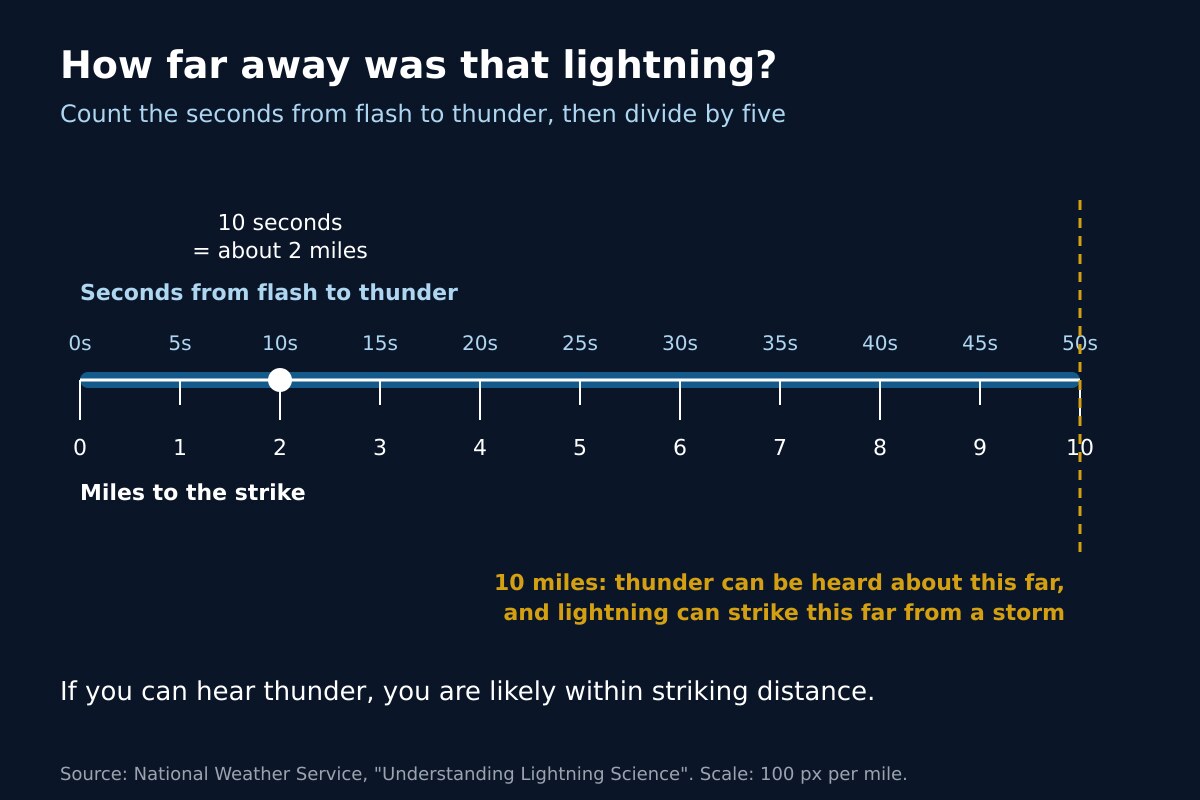
Sound travels about a mile every five seconds. When you see a flash, count the seconds until the thunder, then divide by five: that is roughly how many miles away the strike was. A count of 10 is about two miles. A count of 50 is about 10 miles, which is still inside the distance the Weather Service says lightning can travel from a storm.
Where to go when you hear thunder
The Weather Service’s advice for the beach:
- Watch the sky in all directions, and head to a safe place immediately at any sign of an approaching or developing storm.
- Keep an eye on the forecast and the radar on your phone.
- Safe places are a vehicle or a large, fully enclosed building. A picnic shelter or any other open-sided structure is not safe.
- If you are camping on the beach, keep a hard-topped metal vehicle nearby and get into it at the first sign of a thunderstorm.
Do not shelter under a tree. The Weather Service says most people hurt by a side flash, where lightning hits a taller object and part of the current jumps to someone a foot or two away, had taken shelter under a tree to get out of the rain or hail.
How lightning hurts people
The Weather Service lists five ways lightning strikes people, and any of them can kill:
- Direct strike. The person becomes part of the lightning channel. These are less common than the other kinds but potentially the most deadly, and they most often happen to people in open areas.
- Side flash. Lightning hits a taller object nearby and part of the current jumps to the person.
- Ground current. The energy of a strike travels outward along the ground. Because it covers a much larger area, ground current causes the most lightning deaths and injuries.
- Conduction. Lightning travels through wires, plumbing and other metal. Metal gives lightning a path to follow, and most indoor lightning casualties come from conduction.
- Streamers. Upward discharges that rise from the ground as the lightning approaches. Someone caught in one can be hurt even if the main strike lands elsewhere.
Conduction is the risk indoors. The Weather Service says anyone in contact with something connected to wiring, plumbing or metal that runs outside is at risk during a storm: anything plugged into an outlet, faucets and showers, corded phones, and windows and doors.
If someone is struck
Call 911. The Weather Service says immediate medical attention, including starting CPR and using an AED, may be critically important to keep a person alive until more advanced care arrives. It also notes that lightning injures many more people than it kills, and some survivors live with health problems for the rest of their lives.
The numbers
Lightning strikes the United States about 25 million times a year, and as it passes through the air it can heat it to 50,000 degrees Fahrenheit, about five times hotter than the surface of the sun. It kills about 20 people in the country each year, according to the Weather Service, and severely injures hundreds more. The Weather Service’s preliminary count for 2026 stood at 16 deaths when its tally was last updated on September 22. Most lightning comes in summer, but the Weather Service says people can be struck at any time of year.
Frequently asked questions about lightning safety
Sources
- National Weather Service, Beach Hazards and Safety.
- National Weather Service, Lightning Safety Tips and Resources.
- National Weather Service, Understanding Lightning Science.
- National Weather Service, Five Ways Lightning Strikes People.
- National Weather Service, Lightning Fatalities in 2026 (preliminary, National Lightning Safety Council data).
Before you head out
Check for storms on the live radar, see whether a warning is up on our St. Lucie County alerts page, or open the command center for everything at once. Headed into the water too? Read our guide to rip currents.