Between Sunday, November 1, and midday Tuesday, November 3, 2026, preliminary reports put more than a foot of rain on parts of St. Lucie County. On Wednesday afternoon the National Weather Service office in Melbourne opened its forecast discussion with this:
“Areas affected by catastrophic flooding across southern Brevard County and the Treasure Coast: Avoid flooded roads, and do not walk or wade through floodwater!”
The same discussion expected mostly dry days from Thursday into the weekend, which would let the water recede slowly, and asked residents and visitors to keep avoiding flooded roadways and lingering floodwater in the meantime. This page explains why that advice matters, using the Weather Service and the Centers for Disease Control and Prevention (CDC), linked at the bottom.
How much rain fell
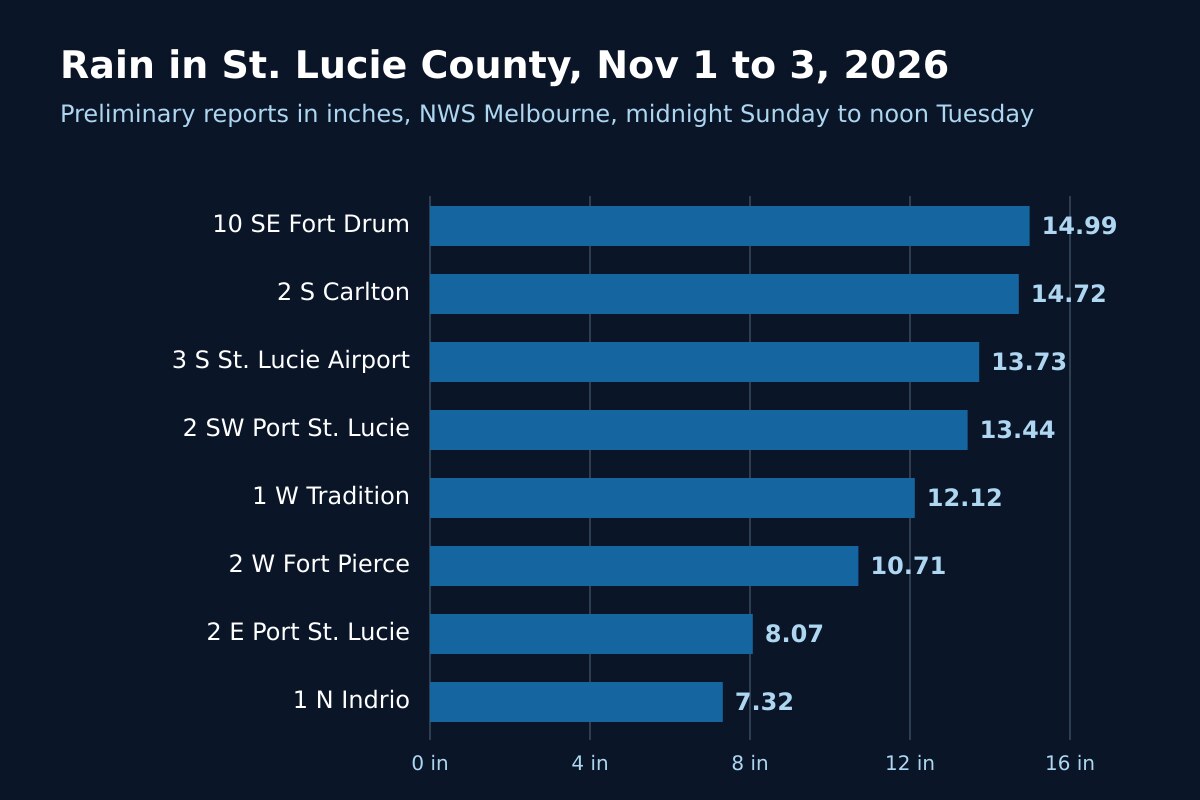
The Weather Service published its count on Tuesday afternoon, covering midnight Sunday to noon Tuesday. It lists 20 reports from St. Lucie County, from 7.25 inches to 16.70 inches, and eight of them topped 12 inches. Near Fort Pierce, a gauge 2 miles west of the city reported 10.71 inches. Around Port St. Lucie, reports ran from 8.07 inches 2 miles east of the city to 13.44 inches 2 miles southwest of it.
The heaviest totals in the statement fell north of us, in southern Brevard County, where a gauge 1 mile north of Grant-Valkaria reported 24.69 inches. Indian River County’s reports reached 14.48 inches and Martin County’s 9.48 inches.
Treat these as early numbers. The statement closes by noting: “Not all data listed are considered official.”
Why a flooded road is a trap
The Weather Service says that each year more deaths occur from flooding than from any other thunderstorm hazard, and it passes on a CDC finding that over half of all flood-related drownings happen when a vehicle is driven into hazardous floodwater. The next largest share comes from people walking into or near floodwater.
The depths involved are smaller than most people expect. From the Weather Service:
- 6 inches of fast-moving floodwater can knock over an adult.
- 12 inches of rushing water can carry away most cars.
- 2 feet of rushing water can carry away SUVs and trucks.
Water over a road also hides the road itself. The Weather Service’s reason for never driving around a barrier at a flooded road is short: “The road may have collapsed under that water.” Its rule is shorter still: “It is NEVER safe to drive or walk into flood waters.” The phrase it uses for all of this is Turn Around Don’t Drown.
Walking and wading
The CDC’s flood guidance says the same thing for people on foot as for drivers: do not drive or walk across flooded roads, because cars and people can be swept away. It adds that floodwater may contain trash, and it lists a few precautions for anyone who has to deal with the water once it is still:
- Wear rubber boots and plastic gloves for cleanup, and wash your hands with soap and water.
- Know when you last had a tetanus shot, in case of a puncture wound or a wound that gets contaminated.
- Expect mosquitoes around pooled water left after a flood. The CDC suggests repellent containing DEET or picaridin, screens, and long sleeves and long pants.
The four flood alerts
The Weather Service issues four flood alerts, each with its own call to action. In its words:
- Flash Flood Warning: Take Action! Issued when a flash flood is imminent or occurring. If you are in a flood-prone area, move immediately to high ground. A flash flood can develop in minutes to hours, and can reach places not getting rain at the time.
- Flood Warning: Take Action! Issued when flooding is imminent or occurring.
- Flood Advisory: Be Aware. Issued when flooding is not expected to be bad enough for a warning, but may cause significant inconvenience and, without caution, could threaten life or property.
- Flood Watch: Be Prepared. Issued when conditions are favorable for flooding. It does not mean flooding will occur, only that it is possible.
Flooding from the ocean side has its own alerts, covered in our king tides guide. Every alert type our area sees is listed in weather alert types explained.
After the water goes down
The CDC’s list for the days after a flood:
- Listen to local officials on how to use water safely for drinking, cooking and cleaning.
- Unplug appliances so they do not shock anyone when the power comes back on. If power lines are down or water is in your home, turn off the gas, power and water.
- Throw away what cannot be disinfected, such as wall coverings, cloth, rugs and drywall.
- Dry the house with fans, air conditioning units and dehumidifiers.
- Clean walls, hard floors and other surfaces with soap and water, then disinfect with 1 cup of bleach in 1 gallon of water.
If the power is out and a generator comes out of the garage, read our portable generator safety page first.
Frequently asked questions about flooded roads in St. Lucie County
Sources
- National Weather Service Melbourne, Area Forecast Discussion, issued 2:33 pm EST, Wednesday, November 4, 2026 (the link always shows the latest issue).
- National Weather Service Melbourne, Public Information Statement, precipitation reports for 12 am Sunday, November 1, through 12 pm Tuesday, November 3, 2026, issued 1:13 pm EST, November 3 (the link shows the latest statement).
- National Weather Service, Turn Around Don’t Drown.
- National Weather Service, Flood Warning vs. Watch.
- Centers for Disease Control and Prevention, Preparing for Floods.
Before the next heavy rain
Check the St. Lucie County alerts page for flood alerts as they are issued, and the live radar to see where the rain is falling, or open the command center for everything at once.