If local officials ask you to evacuate, Ready.gov says, that means your pet should evacuate too. Pets left behind may end up lost, injured or worse. A hurricane plan for pets is the one task on this page: where they can go, what to pack for them, and how to make leaving the house with them a calm few minutes.
Everything here comes from Ready.gov and the Florida Statutes. The Atlantic hurricane season runs June 1 to November 30, and a plan made in the quiet months is ready for the next one.
Where your pet can go if you evacuate
Ready.gov’s warning comes first: many public shelters and hotels do not allow pets inside. Know a safe place where you can take your pets before a storm is on the map.
In Florida, the law gives you one place to ask about. Section 252.3568 of the Florida Statutes, enacted in 2006 and amended in 2020, says:
If a county maintains designated shelters, it must also designate a shelter that can accommodate persons with pets.
The statute does not name the building. St. Lucie County Emergency Management is the office to ask which shelter takes pets. Ready.gov also points to your local animal shelter or animal control office for advice if you are unsure how to care for your pet in an emergency.
Make the plan now
Ready.gov’s plan has four parts:
- An evacuation plan for your pet. A safe place you can take them, settled before a storm comes.
- A buddy system. Neighbors, friends or relatives who will care for or evacuate your pets if you are not able to.
- A microchip. Keep your address and phone number up to date with it, and add an emergency contact outside your immediate area.
- Their hiding places. Note where your pets hide, so you can find them quickly if you have to leave the house in a hurry.
Build a kit for your pet
Ready.gov suggests two kits: a larger one for sheltering in place and a lightweight one for evacuating. Start with the basics for survival, food and water, and review both kits regularly so the food and medicine stay fresh.
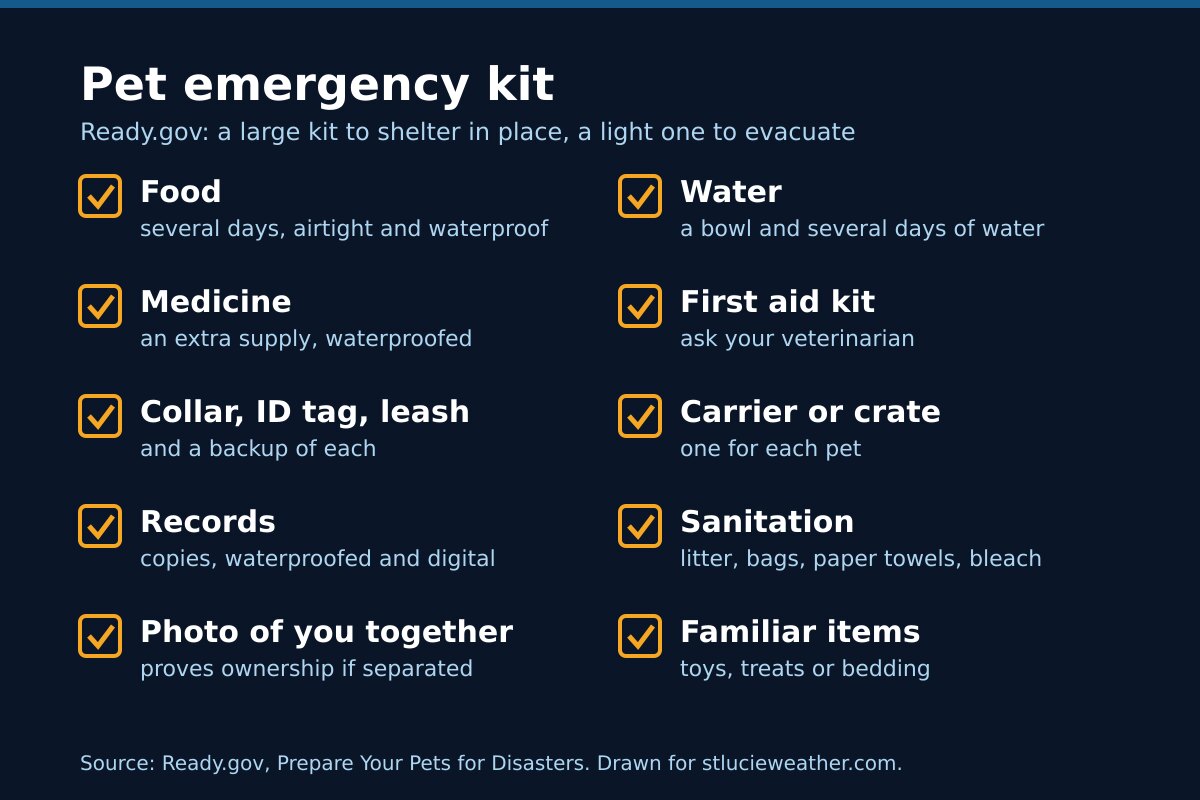
- Food: several days’ supply in an airtight, waterproof container.
- Water: a water bowl and several days’ supply of water. Our hurricane water storage guide covers storing it.
- Medicine: an extra supply of anything your pet takes regularly, in a waterproof container.
- First aid kit: ask your veterinarian what suits your pet’s emergency medical needs.
- Collar with ID tag, and a harness or leash, with a backup of each.
- Records: copies of your pet’s registration and other documents in a waterproof container, and available electronically. Our hurricane documents page covers copying your own papers the same way.
- A traveling bag, crate or sturdy carrier, ideally one for each pet.
- Grooming and sanitation: pet shampoo, litter and a litter box if needed, newspapers, paper towels, plastic trash bags and household chlorine bleach.
- A picture of you and your pet together, to document ownership and help others identify your pet if you are separated.
- Familiar items: favorite toys, treats or bedding, which can help reduce your pet’s stress.
Get them used to the carrier
Ready.gov notes that you may need to put a cat or dog into a carrier to evacuate, so it helps if the animal is already comfortable with it. Its steps:
- Leave the carrier out in places your pet often visits.
- Leave it open.
- Feed treats near the carrier, and try putting a few inside it.
- Put a favorite blanket or small bed inside so it smells familiar.
Horses, goats and other large animals
For animals such as horses, goats or pigs, Ready.gov adds these steps to everything above:
- Make sure every animal has some form of identification.
- Evacuate earlier whenever possible, and map primary and secondary routes in advance.
- Line up the vehicles and trailers each kind of animal needs, and experienced handlers and drivers.
- Make sure the destination has food, water, veterinary care and handling equipment.
If evacuation is not possible, Ready.gov says, owners must decide whether to move large animals to a barn or turn them loose outside.
When a storm is coming
Ready.gov’s last rule is the simplest: bring pets indoors at the first sign or warning of a storm. Pay attention to wireless emergency alerts, and listen to local officials when they tell you to evacuate or shelter in place.
Frequently asked questions about hurricane plans for pets
Sources
- Ready.gov, Prepare Your Pets for Disasters (the plan, the kit, carrier training, large animals, staying informed).
- Florida Statutes, section 252.3568, Emergency sheltering of persons with pets (Online Sunshine; history: chapter 2006-71, amended by chapter 2020-132).
- Ready.gov, Hurricanes (season dates).
Before the next storm
Watch what is coming with our St. Lucie County alerts page and the live radar, or open the command center for everything at once. The rest of the household kit is in our hurricane preparedness guide.