After a hurricane, clean drinking water may not be available. Ready.gov puts it plainly: your regular water source could be cut off or compromised through contamination. Hurricane water storage is the one task on this page: how much to keep, how to store it so it is still good when you need it, and what to do if the stored water runs out before the tap comes back.
Everything here comes from Ready.gov and the U.S. Environmental Protection Agency (EPA). The Atlantic hurricane season runs June 1 to November 30, and water you store now will serve the next one, as long as you rotate it.
How much water to store
Ready.gov’s rule is at least one gallon of water per person per day for several days, for drinking and sanitation. A normally active person needs about three quarters of a gallon of fluid a day from water and other drinks.
Ready.gov says to plan for more in these cases:
- Children, nursing mothers and sick people may need more water.
- A medical emergency might require more.
- In a warm climate more water may be necessary, and in very hot temperatures water needs can double. A Treasure Coast power outage in late summer, with no air conditioning, is that case.
Our hurricane preparedness guide covers the rest of the supply kit, including water for pets and filling bathtubs for flushing and washing the day before a storm.
How to store water so it keeps
Store-bought is simplest. Ready.gov recommends commercially bottled water, kept in its sealed original container in a cool, dark place.
If you fill your own containers, Ready.gov’s steps are:
- Use food-grade water storage containers.
- Clean them thoroughly with dishwashing soap.
- Sanitize them with a solution of one teaspoon of unscented liquid household chlorine bleach to a quart of water.
- Fill them with chlorinated water.
- Replace water you bottled yourself every six months.
A date written on each container makes the six-month swap easy to keep.
If the stored water runs out
The EPA points to water already in the house: melting ice cubes, or draining the hot water tank or the pipes. It also allows river or lake water, preferring flowing water to still water, but never water with floating material in it, a dark color or a questionable odor. Whatever the source, treat it before you drink it.
Ready.gov adds rules for the days in between. Never ration drinking water unless the authorities order it: drink what you need today and try to find more for tomorrow. Drink water you know is clean first, and put off suspicious water as long as you can without becoming dehydrated. Skip coffee, soda and alcohol in place of water, because caffeine and alcohol dehydrate the body.
How to make water safe to drink
After a hurricane or flood, the EPA says, local authorities may tell you to use only bottled, boiled or disinfected water until regular service is restored. That treated water is for drinking, cooking, making any prepared drink, washing dishes and brushing teeth, and Ready.gov adds making ice.
First, clear it. If the water is cloudy, let it settle, then filter it through a clean cloth, a paper towel or a coffee filter.
Boil it if you can. Ready.gov calls boiling the safest method. Bring the water to a rolling boil for at least one minute, let it cool, and store it in clean covered containers. Boiled water tastes flat; pouring it back and forth between two clean containers, or adding a pinch of salt to each quart, improves it.
Use bleach if you cannot boil. The EPA’s instructions:
- Use only regular, unscented chlorine bleach whose label says it is suitable for disinfection and sanitization. The label may give the active ingredient as 6 or 8.25 percent sodium hypochlorite. Never use scented or color-safe bleach, or bleach with added cleaners.
- Use fresh bleach, or bleach stored at room temperature for less than a year, and a clean dropper.
- Add the amount in the chart below, and double it if the water is cloudy, colored or very cold.
- Stir and let it stand for 30 minutes. The water should have a slight chlorine odor. If it does not, repeat the dose and let it stand another 15 minutes.
- If the chlorine taste is too strong, pour it between clean containers and let it stand a few hours.
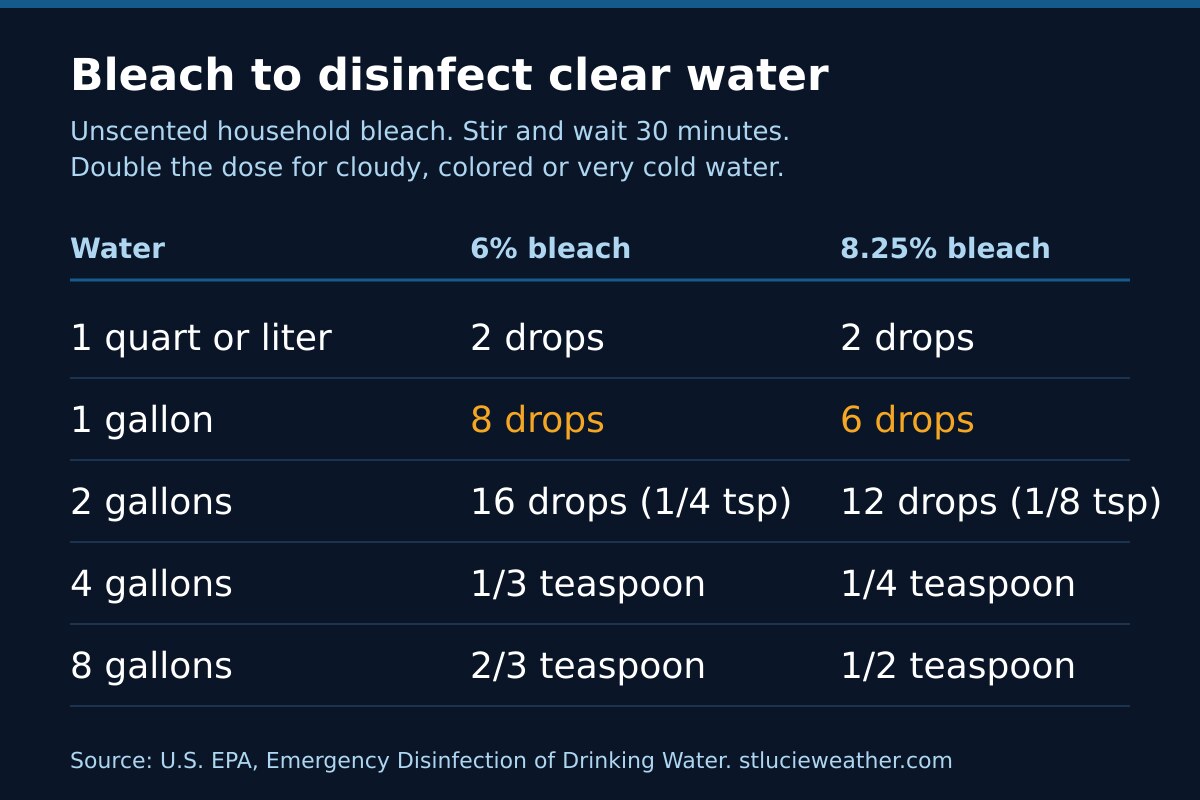
- 1 quart or liter: 2 drops of 6% bleach, or 2 drops of 8.25%.
- 1 gallon: 8 drops of 6%, or 6 drops of 8.25%.
- 2 gallons: 16 drops (1/4 teaspoon) of 6%, or 12 drops (1/8 teaspoon) of 8.25%.
- 4 gallons: 1/3 teaspoon of 6%, or 1/4 teaspoon of 8.25%.
- 8 gallons: 2/3 teaspoon of 6%, or 1/2 teaspoon of 8.25%.
What boiling and bleach cannot do. Both kill most germs, but the EPA notes that neither removes heavy metals, salts or most other chemicals. Ready.gov describes distillation for those: fill a pot halfway, tie a cup to the lid handle so it hangs right side up, clear of the water, when the lid is upside down, and boil for 20 minutes. The water that drips from the lid into the cup is distilled.
On a private well, the EPA says a well that has flooded should be disinfected and tested after the flood; your state or local health department can advise.
Frequently asked questions about hurricane water storage
Sources
- Ready.gov, Water (how much to store, storing and rotating it, drinking tips, boiling and distillation).
- U.S. EPA, Emergency Disinfection of Drinking Water (when treated water is needed, other sources at home, boiling, the bleach table, private wells).
- Ready.gov, Hurricanes (season dates).
Before the next storm
Watch what is coming with our St. Lucie County alerts page and the live radar, or open the command center for everything at once. While you are putting the kit together, copy your papers with hurricane documents, and read portable generator safety before the generator comes out.